Hope Valley Reservoir Reserve Restoration

Share Hope Valley Reservoir Reserve Restoration on Facebook Share Hope Valley Reservoir Reserve Restoration on X (formerly Twitter) Share Hope Valley Reservoir Reserve Restoration on Linkedin Email Hope Valley Reservoir Reserve Restoration link

September 2026 update

There will be upcoming activity within the Hope Valley Reservoir Reserve, as efforts continue to manage an outbreak of the pest insect giant pine scale (GPS).

Following the initial GPS outbreak, monitoring has continued in affected areas and a further detection was recently identified in one Aleppo Pine tree within the eastern side of the reserve near Awoonga Road.

The infected tree has already been felled, with further work planned in coming weeks to remove susceptible trees within a 50-metre buffer zone of the detection.

The Aleppo pines being removed are not native pine trees, and no native trees will be removed.

These trees are in an area of the reserve that is not accessible to the public, so there will be no impact to visitor access during the tree removal works. To help prevent the spread of GPS, the felled trees will be quarantined on-site before being disposed of in accordance with biosecurity considerations.

Following necessary quarantine periods, revegetation in the impacted areas will be guided by a restoration plan which will prioritise establishment of native vegetation, consistent with SA Water’s broader land use management approach.

A working group, including our Principle Restoration Ecologist, is rolling out our restoration plan over the next 12 months.

SA Water and the Department of Primary Industries and Regions will continue regular surveillance for GPS within Hope Valley Reservoir Reserve and provide further updates to the community where required.

For more information on GPS, visit the Department for Primary Industries and Regions (PIRSA) website.

May 2026 update

From Monday 11 May, walking trails will reopen to visitors within the northern end of Hope Valley Reservoir Reserve – adjacent to Grand Junction Road and Carlsson Place, as well as along Delray Avenue.

This follows a temporary closure during works to fell and mulch Aleppo Pine trees within this section of the reserve, which had been identified as infested or at risk of infestation from the pest insect, giant pine scale (GPS).

This work is separate to the project detailed on this page.

Further surveillance for GPS within Hope Valley Reservoir Reserve is planned for later this year, which will determine if further pine tree removal is required. Building on revegetation already completed in the south-eastern section of the reserve, we are also developing a rehabilitation plan for other areas impacted by GPS.

We will provide the community updates on this work as it progresses.

For more information on GPS, visit the Department for Primary Industries and Regions (PIRSA) website.


April 2026

After several months of work, the south-east corner of Hope Valley Reservoir Reserve – including the Lorikeet Loop – has now reopened to visitors.

The upgrades feature a sustainable stormwater design comprised of swales and basins, which contain rocks and native plants. This design improves local habitat and will slow down the flow of stormwater from nearby Lower North East Road, helping to limit erosion and water entering the reservoir during high rainfall events.

We’ve also added additional signage to complement the upgrades, and CCTV cameras for site security.

Two hectares of native grass meadows and tube stock plantings, planted late last year, are now well established and germinating following the 2025-26 summer.

While this area is now open for everyone to enjoy, further improvements are on the way. Ongoing works will focus on additional revegetation, scheduled to continue until around mid-2026.


February 2026 update

From Monday 16 February, the south-east corner of the Hope Valley Reservoir Reserve will be closed for approximately 5 weeks.

This is for the safety of our crews and visitors while we undertake planned stormwater management works.

During this time, the Lorikeet Loop will be rerouted onto footpaths along Lyons Road, Lower North East Road and Awoonga Road.

Please observe signage and detours in place while works are underway.


December 2025 update

After several months of dedicated work, the bulk of revegetation within the south-eastern section of Hope Valley Reservoir Reserve is now complete, with the area opening to visitors for the first time in early December 2025.

A mixture of more than 1,500 native trees, plants, shrubs and grasses – comprising 31 species – have been planted, with further planting and other improvements such as stormwater management works planned during 2026.

We encourage you to visit the newly opened area of the reserve, where you can also enjoy:

  • 1.2 kilometres of shared use trails for walking, running and cycling
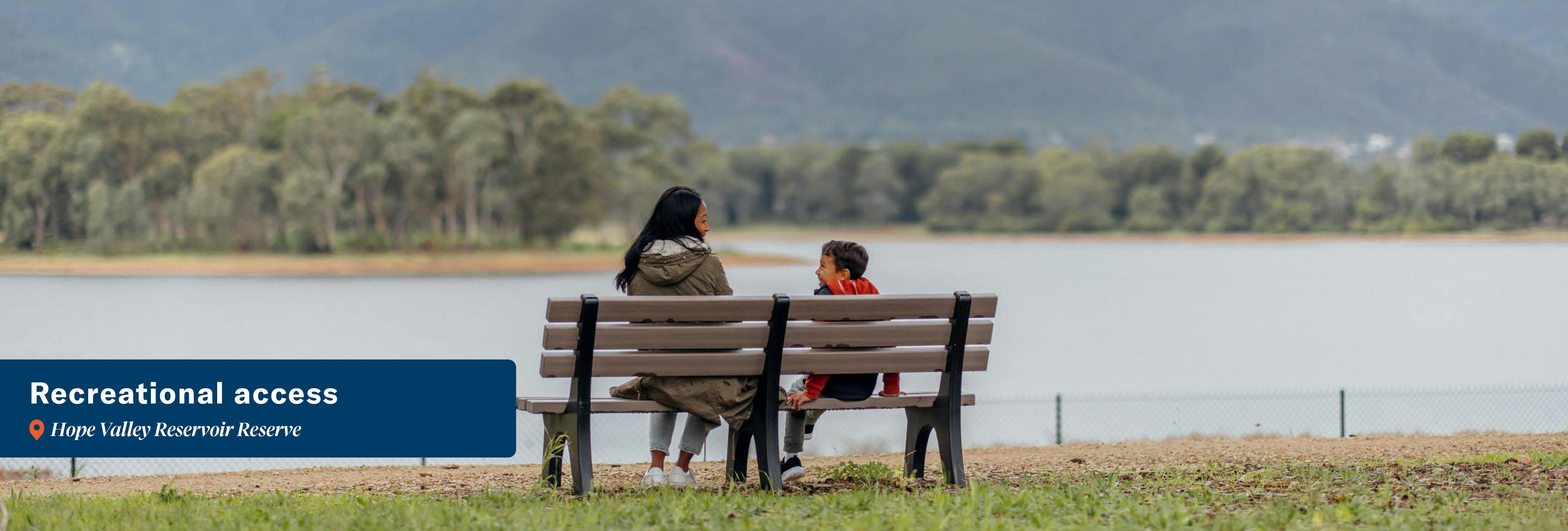
  • 2 new shelters and benches with views across the reservoir
  • upgraded fencing and a safe elevated platform to cross the reservoir inlet.


Live, work or play at Hope Valley?

We are excited to announce that we will soon commence revegetation – and launch improvements to the trail network - in the southeast area of Hope Valley Reservoir Reserve.

Thank you to all those that provided feedback on the draft concept design during the public consultation period, which ended on 31 October 2024.

These improvements are essential to revegetating an area which was impacted by Giant Pine Scale, requiring the removal of infected pine trees. Giant Pine Scale is an insect that sucks the sap of pine trees and causes dieback.

Some of the ways we’re looking to make Hope Valley better for our community include:

  • rehabilitating the area decimated by Giant Pine Scale including removing mulch piles
  • revegetating this zone with local Indigenous plant species
  • constructing a walking trail that links Hope Valley’s dam wall with Awoonga Road
  • enhancing the visitor experience by increasing accessibility and establishing new seating locations.

If you have any queries, or would like to know more, please contact reservoirs@sawater.com.au.

September 2026 update

There will be upcoming activity within the Hope Valley Reservoir Reserve, as efforts continue to manage an outbreak of the pest insect giant pine scale (GPS).

Following the initial GPS outbreak, monitoring has continued in affected areas and a further detection was recently identified in one Aleppo Pine tree within the eastern side of the reserve near Awoonga Road.

The infected tree has already been felled, with further work planned in coming weeks to remove susceptible trees within a 50-metre buffer zone of the detection.

The Aleppo pines being removed are not native pine trees, and no native trees will be removed.

These trees are in an area of the reserve that is not accessible to the public, so there will be no impact to visitor access during the tree removal works. To help prevent the spread of GPS, the felled trees will be quarantined on-site before being disposed of in accordance with biosecurity considerations.

Following necessary quarantine periods, revegetation in the impacted areas will be guided by a restoration plan which will prioritise establishment of native vegetation, consistent with SA Water’s broader land use management approach.

A working group, including our Principle Restoration Ecologist, is rolling out our restoration plan over the next 12 months.

SA Water and the Department of Primary Industries and Regions will continue regular surveillance for GPS within Hope Valley Reservoir Reserve and provide further updates to the community where required.

For more information on GPS, visit the Department for Primary Industries and Regions (PIRSA) website.

May 2026 update

From Monday 11 May, walking trails will reopen to visitors within the northern end of Hope Valley Reservoir Reserve – adjacent to Grand Junction Road and Carlsson Place, as well as along Delray Avenue.

This follows a temporary closure during works to fell and mulch Aleppo Pine trees within this section of the reserve, which had been identified as infested or at risk of infestation from the pest insect, giant pine scale (GPS).

This work is separate to the project detailed on this page.

Further surveillance for GPS within Hope Valley Reservoir Reserve is planned for later this year, which will determine if further pine tree removal is required. Building on revegetation already completed in the south-eastern section of the reserve, we are also developing a rehabilitation plan for other areas impacted by GPS.

We will provide the community updates on this work as it progresses.

For more information on GPS, visit the Department for Primary Industries and Regions (PIRSA) website.


April 2026

After several months of work, the south-east corner of Hope Valley Reservoir Reserve – including the Lorikeet Loop – has now reopened to visitors.

The upgrades feature a sustainable stormwater design comprised of swales and basins, which contain rocks and native plants. This design improves local habitat and will slow down the flow of stormwater from nearby Lower North East Road, helping to limit erosion and water entering the reservoir during high rainfall events.

We’ve also added additional signage to complement the upgrades, and CCTV cameras for site security.

Two hectares of native grass meadows and tube stock plantings, planted late last year, are now well established and germinating following the 2025-26 summer.

While this area is now open for everyone to enjoy, further improvements are on the way. Ongoing works will focus on additional revegetation, scheduled to continue until around mid-2026.


February 2026 update

From Monday 16 February, the south-east corner of the Hope Valley Reservoir Reserve will be closed for approximately 5 weeks.

This is for the safety of our crews and visitors while we undertake planned stormwater management works.

During this time, the Lorikeet Loop will be rerouted onto footpaths along Lyons Road, Lower North East Road and Awoonga Road.

Please observe signage and detours in place while works are underway.


December 2025 update

After several months of dedicated work, the bulk of revegetation within the south-eastern section of Hope Valley Reservoir Reserve is now complete, with the area opening to visitors for the first time in early December 2025.

A mixture of more than 1,500 native trees, plants, shrubs and grasses – comprising 31 species – have been planted, with further planting and other improvements such as stormwater management works planned during 2026.

We encourage you to visit the newly opened area of the reserve, where you can also enjoy:

  • 1.2 kilometres of shared use trails for walking, running and cycling
  • 2 new shelters and benches with views across the reservoir
  • upgraded fencing and a safe elevated platform to cross the reservoir inlet.


Live, work or play at Hope Valley?

We are excited to announce that we will soon commence revegetation – and launch improvements to the trail network - in the southeast area of Hope Valley Reservoir Reserve.

Thank you to all those that provided feedback on the draft concept design during the public consultation period, which ended on 31 October 2024.

These improvements are essential to revegetating an area which was impacted by Giant Pine Scale, requiring the removal of infected pine trees. Giant Pine Scale is an insect that sucks the sap of pine trees and causes dieback.

Some of the ways we’re looking to make Hope Valley better for our community include:

  • rehabilitating the area decimated by Giant Pine Scale including removing mulch piles
  • revegetating this zone with local Indigenous plant species
  • constructing a walking trail that links Hope Valley’s dam wall with Awoonga Road
  • enhancing the visitor experience by increasing accessibility and establishing new seating locations.

If you have any queries, or would like to know more, please contact reservoirs@sawater.com.au.

Page published: 23 Sep 2026, 02:39 PM